Medically reviewed by Matthew Lyons, MD
Few shoulder diagnoses get handed out as freely as shoulder impingement syndrome. By the time patients reach my office in Renton or Maple Valley, many have already been told they have shoulder impingement by a trainer, a friend, or a search engine. Sometimes the label fits. It describes pain on the outside of the shoulder when you lift your arm, coming from the rotator cuff tendons and the bursa that sits over them. The name suggests a bone spur pinching those tendons, but in most shoulders the real story is how the tendon and the shoulder blade are working together. That difference shapes how I test for it and how I treat it.
Key Takeaways
- Shoulder impingement syndrome, now also called subacromial pain syndrome, is pain from irritated rotator cuff tendons and the bursa above them when the arm is raised.
- A hands-on exam carries most of the diagnosis. X-rays come first, and MRI is saved for suspected tears or shoulders that don’t improve.
- A structured strengthening program is the first-line treatment. An injection can calm pain enough to let the exercises work.
What Shoulder Impingement Syndrome Actually Is
The rotator cuff is a group of four tendons that wrap the ball of the shoulder. The top tendon, the supraspinatus, runs through a narrow space under the acromion, the bony shelf at the top of the shoulder. A thin, fluid-filled sac called the subacromial bursa cushions that space.
When the tendon or bursa becomes irritated, lifting the arm hurts. The traditional explanation was mechanical: the acromion or a bone spur rubbed the tendon every time the arm went up. That view explains part of the story. It doesn’t explain why plenty of people have a hooked acromion or a spur on X-ray and no pain at all.
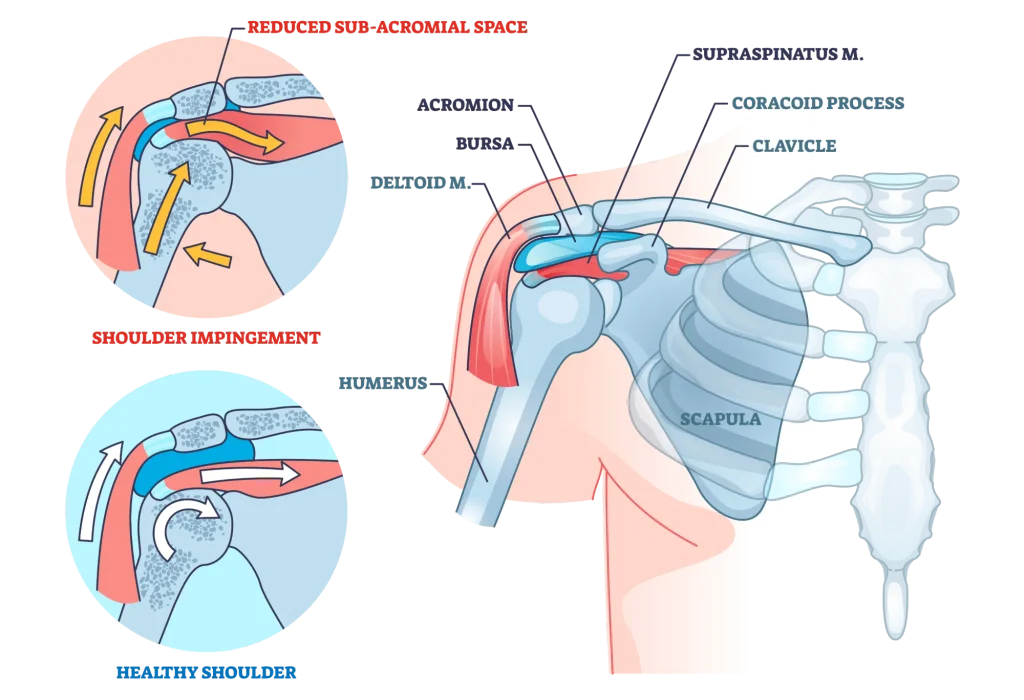
For that reason, many shoulder specialists now use the term subacromial pain syndrome. It names where the pain lives without assuming the bone is to blame.
What Causes It
Shoulder impingement syndrome builds gradually in most people rather than following a single injury. Three factors come up again and again:
- Repetitive overhead load. Painting a ceiling, stocking high shelves, swimming laps, or serving in tennis loads the cuff in the position where it has the least room.
- Tendon changes with age. From the 40s onward, cuff tendons lose some of their resilience. A tendon that handled years of overhead work may start to complain.
- How the shoulder blade moves. When the muscles that steer the shoulder blade are weak or fatigued, the space under the acromion narrows as the arm lifts.
Bone spurs deserve a mention. A spur under the acromion can show up on an X-ray, yet in plenty of shoulders it is a bystander. I would rather fix how the shoulder moves than chase a spur that might not be causing the pain.
The Symptoms That Point to Impingement
The usual symptom is pain on the outer upper arm, near the deltoid rather than on top of the shoulder, when the arm is raised. Two features help separate it from other problems.
The first is a painful arc. Lifting the arm out to the side hurts through the middle of the motion, around shoulder height, and then eases once the arm is fully up. The second is night pain, especially when lying on the affected side. Lost sleep is one of the most common reasons people finally book a visit.
Significant weakness should not be part of the picture. If you can’t lift the arm, or it drops when you try to hold it out, that raises concern for a rotator cuff tear, which is a different conversation. Stiffness in every direction points elsewhere too, toward frozen shoulder or shoulder arthritis.
How I Test for Shoulder Impingement
The exam carries most of the weight. I watch how the shoulder and shoulder blade move from behind, then test the strength of each cuff tendon on its own. Two classic maneuvers, the Neer and Hawkins-Kennedy tests, position the arm to load the tendon under the acromion. Neither one is definitive. A pattern of findings is what builds a diagnosis.
I completed fellowships in both sports medicine and hand surgery at the University of Virginia, so I look at the whole arm, not just the shoulder. A pinched nerve in the neck can produce pain over the shoulder blade and down the arm. Anyone whose pain travels below the elbow, or comes with numbness or tingling, gets a neck exam too.
X-rays are usually the first images I order. They show bone spurs, arthritis, and calcium deposits in the tendon. MRI isn’t needed for everyone. I order one when weakness suggests a tear, when symptoms haven’t improved with a solid course of rehab, or when surgery is on the table. Whatever images we get, I go through them with you on the screen during the visit.
What I See in My Patients
Many of the people I see with this problem are in their 40s and 50s, and they can name the project that started it. A spring spent rebuilding a deck. A new pickleball habit. A warehouse job in the Kent Valley that added hours of overhead reaching.
The pattern I try hardest to break is rest-and-return. A patient rests the shoulder for two weeks, the pain fades, they go back to the same load, and it flares. Rest calms the tendon, but it doesn’t make the tendon any stronger. After several rounds, the shoulder is sore and weaker than when it started.
I also meet shoulders that have carried the impingement label for a year or more without a proper exam. Some turn out to have a partial or full-thickness cuff tear. Others have early arthritis or a stiff capsule. A diagnosis that isn’t improving deserves a second look, not a fourth round of the same treatment.
My Approach to Treating Shoulder Impingement Syndrome
For the large majority of patients, treatment starts without surgery, and the core of it is exercise. That matches where current guidelines have landed. A good program does three things: it calms the irritated tendon, strengthens the rotator cuff, and retrains the muscles that control the shoulder blade.
I ask patients to give a well-run program a real chance before we judge it. Progress in the first few weeks can be slow, and I would rather set that expectation at the first visit than have someone quit in week three.
Pain has to be manageable for the exercises to work. Anti-inflammatory medication, used with your primary doctor’s input, may help for short stretches. When pain blocks progress, a corticosteroid injection into the bursa can quiet things down enough to let therapy do its job. I think of the injection as a window, not a cure. I keep the number of injections limited, because repeated steroid exposure can weaken tendon tissue.
If a well-run program hasn’t helped, I look again for another cause, such as a rotator cuff tear, before we talk about surgery. Arthroscopic subacromial decompression, which shaves bone from the underside of the acromion, has been used for impingement, though recent placebo-controlled trials have questioned its benefit when pain is the only problem.
Summary
Shoulder impingement syndrome is pain from irritated cuff tendons and the bursa above them, not simply a bone spur pinching a tendon. It shows up as a painful arc and night pain, while real weakness points toward something more. The exam leads the diagnosis, and imaging confirms it when needed. A consistent strengthening program is the foundation of treatment, injections play a supporting role, and surgery is considered only when nonsurgical care hasn’t helped.
If your shoulder has hurt with overhead reaching for more than a few weeks, or hasn’t improved after a round of therapy, have it examined. Bring any prior X-rays or MRI reports and a list of what you have already tried. Request an appointment at my Renton or Maple Valley office, and we will sort out what is driving the pain.
Frequently Asked Questions
Is shoulder impingement the same as a rotator cuff tear?
No. Impingement describes irritation of the cuff tendons and bursa. A tear is a structural break in the tendon. The two can overlap, and long-standing tendon irritation may come before some degenerative tears. Weakness is the main clue that a tear could be present.
Can shoulder impingement heal on its own?
Symptoms can settle with activity changes, but rest alone leads to a flare for a lot of people once normal activity resumes. A structured strengthening program gives a better chance of lasting relief.
How long does it take to recover from shoulder impingement?
It varies. I ask patients to give a well-run physical therapy program a real chance before we judge the result, and some improve within the first several weeks. If a full program hasn’t helped, that is a signal to look for another cause.
Do I need an MRI for shoulder impingement?
Not always. An exam and X-rays are enough to start treatment for the majority of patients. MRI is useful when weakness suggests a tear, when rehab hasn’t helped, or when surgery is being considered.